
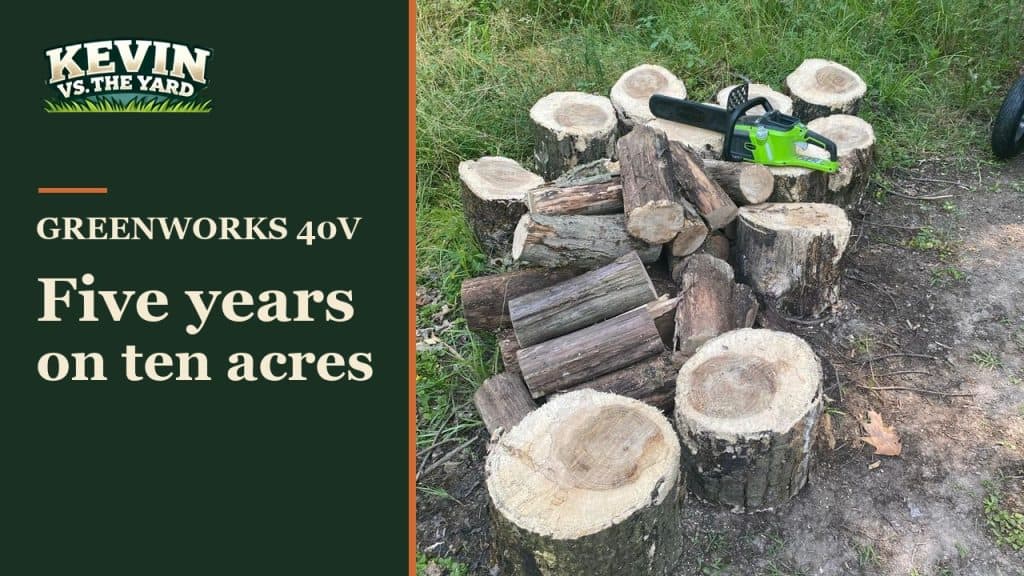
Five years. Ten acres. Fallen white pines, oak trees, countless hours of cutting, at least three dead batteries and roughly $400 in battery replacements.
And yet, my Greenworks 40V chainsaw is still running smoothly.
When I originally purchased my Greenworks 40V 16-inch brushless cordless chainsaw, I had no idea just how much work this little machine would eventually have to deal with.
Looking back, I was probably asking quite a bit more of it than I should have.
But before I get into my experience with this particular chainsaw, I should explain how I ended up purchasing one in the first place.
How I ended up with a cordless chainsaw
Before my wife and I purchased our ten-acre property in northeastern Ohio in 2020, we lived in a small townhouse near Lake Erie with a tiny yard.
Before that, we had spent much of our time living in the Valley in Arizona, in Mesa and San Tan Valley.
That is to say, we didn't move to our new property with an impressive collection of outdoor power equipment. We didn't own much of it, nor had we ever needed it.
And now we suddenly owned ten acres.
Five acres of meadow and another five acres encompassing pine woods and mixed hardwood forests.
To say that we were severely under-equipped would probably be an understatement. In many ways, we had absolutely no idea what we were getting ourselves into.
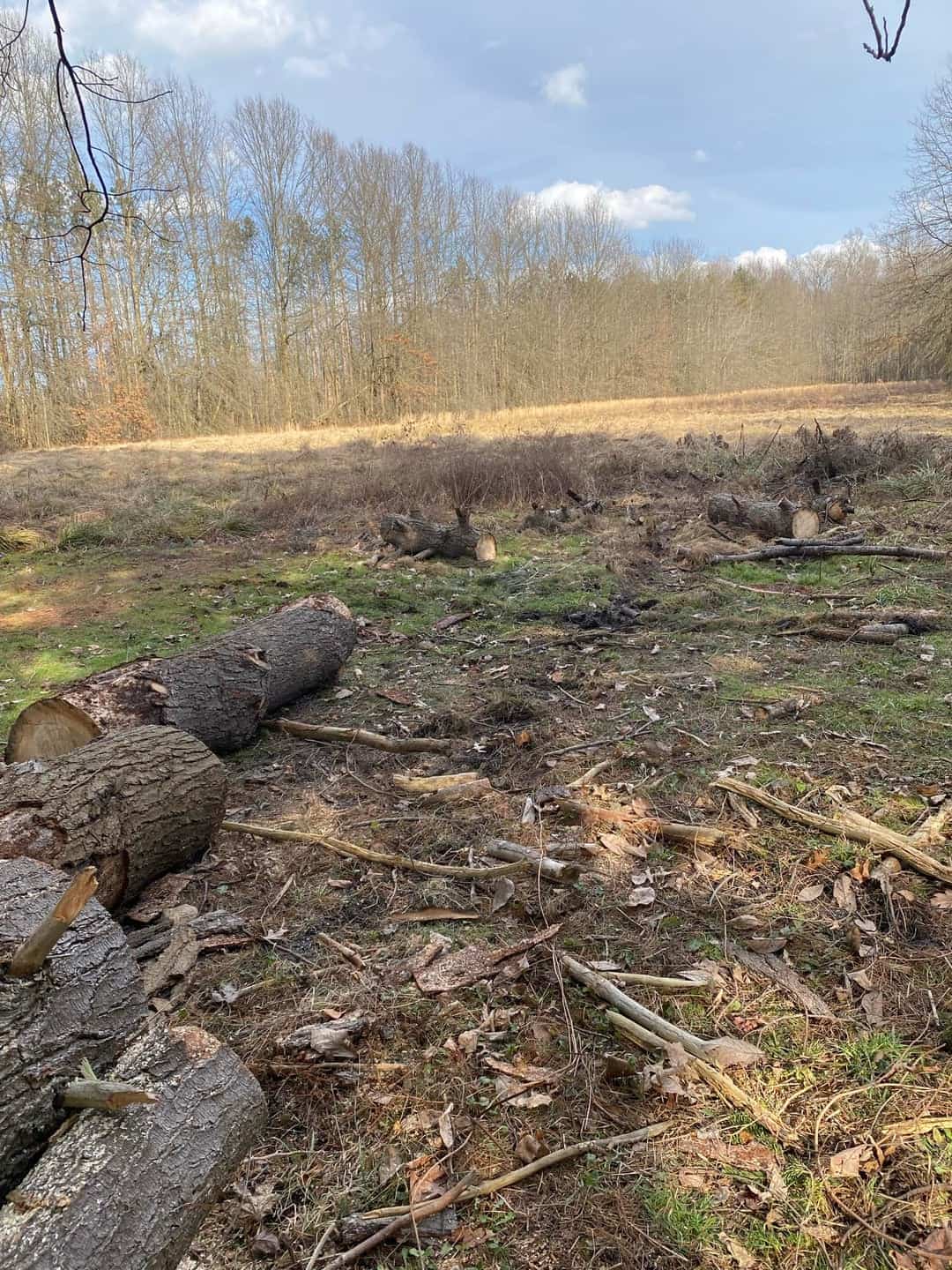
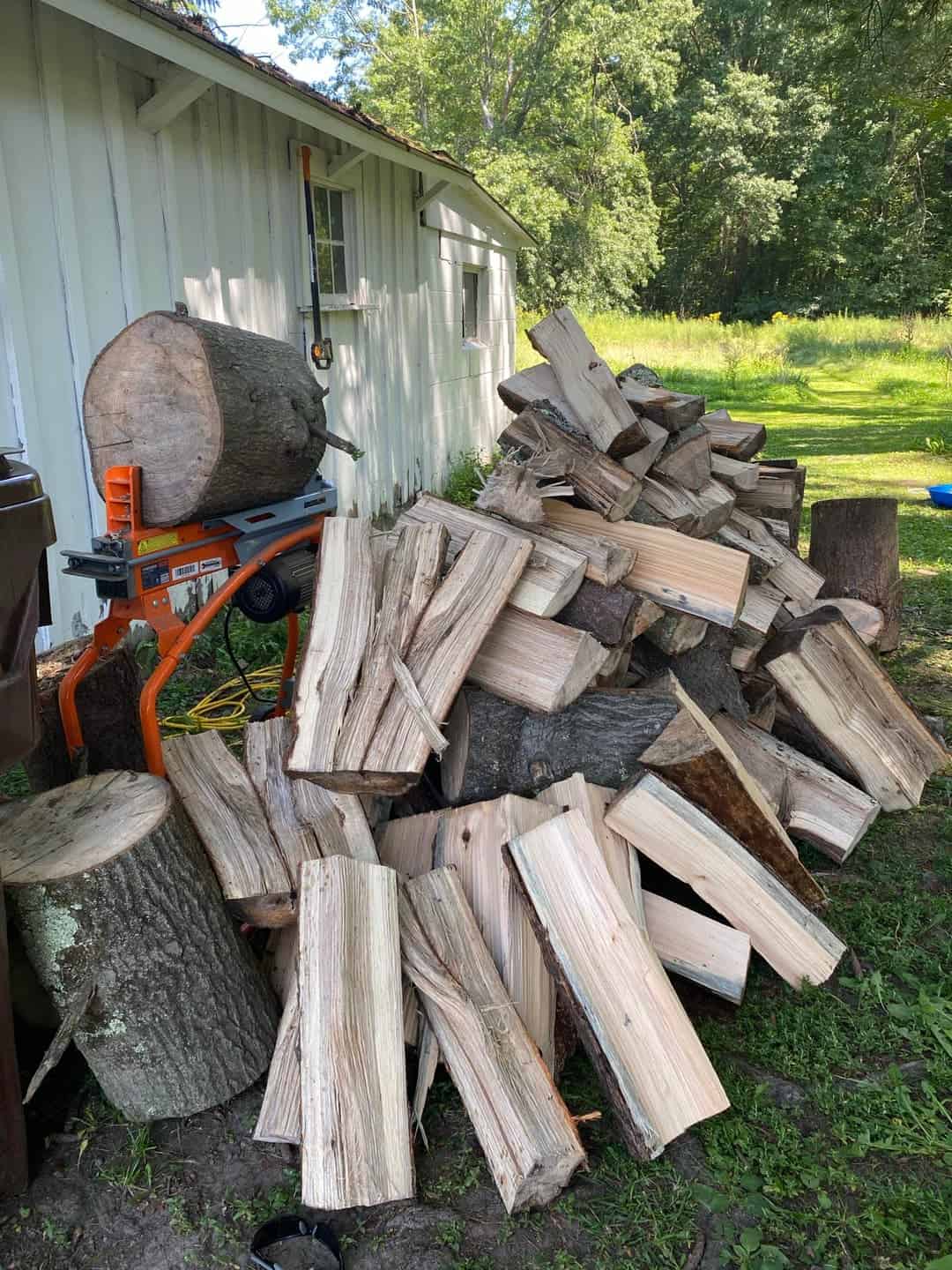
The previous owner had clearly spent some time working on the white pines scattered throughout the property. Logs and pieces of split wood could be found in various places.
Considering that our new home had both a fireplace and a wood stove, we figured it was about time to equip ourselves with some tools to maintain the property and prepare our own firewood.
That's where my relationship with Greenworks began.
I decided to purchase the Greenworks 40V 16-inch Brushless Cordless Chainsaw with a 4.0Ah battery and charger, model 20312.
At the time, I figured a cordless battery chainsaw might be all I needed to work through the existing white pine logs, cut them into manageable pieces and split them with my Fiskars hand axe.
And yes, I spent the first two to three years splitting wood with that axe before eventually purchasing an electric log splitter.
I researched the specifications of the Greenworks chainsaw online, and several things appealed to me as someone who had very little experience with outdoor power equipment.
No gasoline to purchase. No fuel mixture to worry about. No starter cord to pull. A rechargeable battery that could potentially be used with other Greenworks 40V tools.
It all sounded rather convenient.
For reference, Greenworks lists a 40V brushless motor, a 16-inch bar, and a 4.0Ah battery and charger for model 20312.
Source: Greenworks official product information.
I figured, why not give it a try? Surely it would be more convenient than constantly having to refuel a gasoline chainsaw.
When the trees started coming down
What I hadn't accounted for was the amount of storm damage we would experience on our property over the coming years.
Living in northeastern Ohio has taught me quite a few things about early spring and summer storms.
One of them is that trees come down. Sometimes a lot of them.
In 2023 alone, I counted as many as nine trees that had fallen on our property within a matter of a few months.
We have quite a few pitch pines along the western edge of our property, and I've repeatedly found them lying on the ground after major storms.
Then there are the much larger white pines and hardwood trees scattered throughout our woods.
Suddenly, the little Greenworks 40V chainsaw I had purchased to cut some existing logs had become my primary piece of equipment for dealing with storm damage.
It was, in fact, the only chainsaw I owned during those early years.
And I certainly wasn't gentle with it.
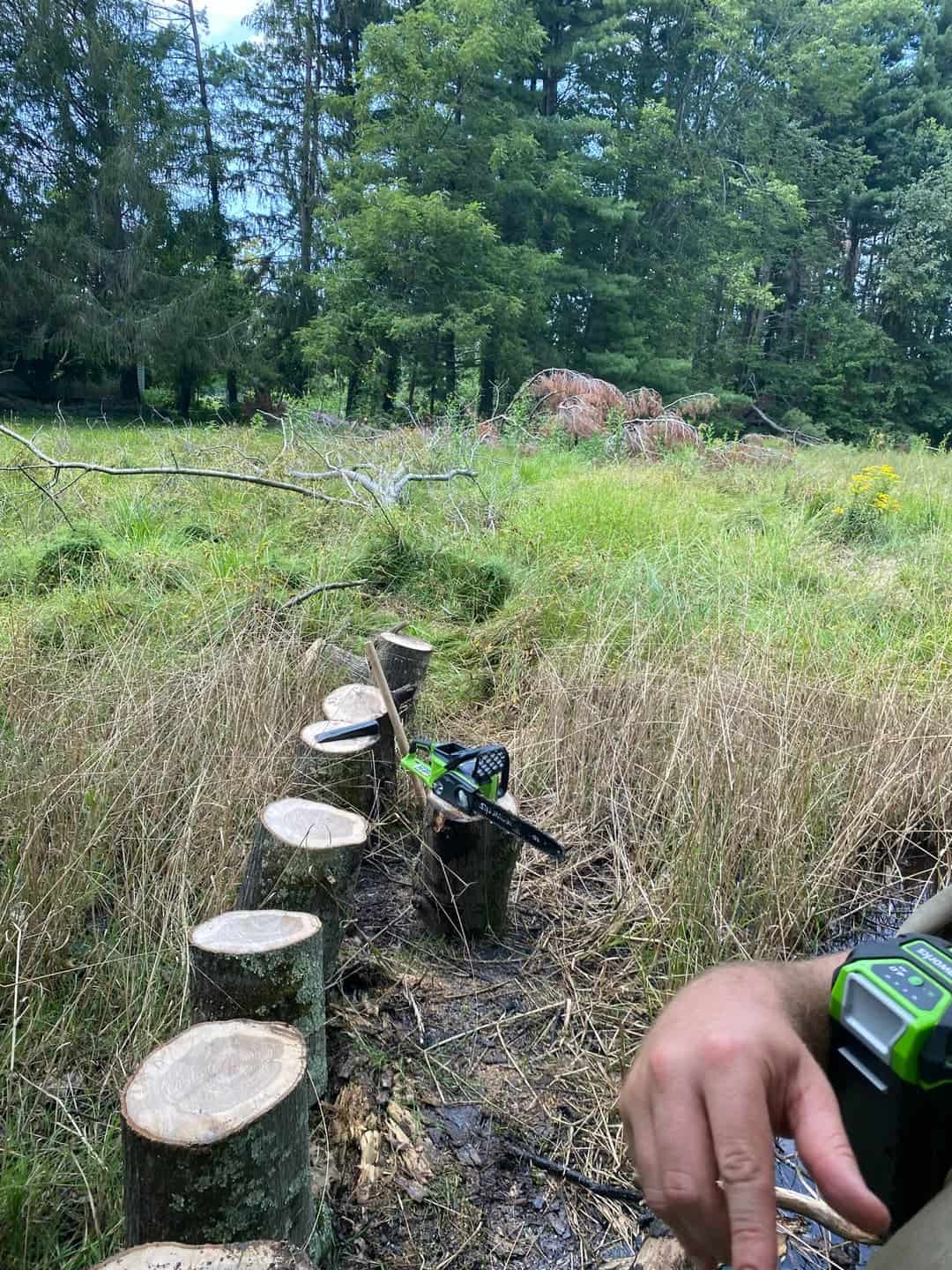
One of the things I appreciated from the beginning was how straightforward this chainsaw was for someone like myself.
It isn't particularly bulky, and I find it light and comfortable to handle compared with some of the gasoline chainsaws I own today.
Starting it is remarkably easy. There is no pulling a starter cord, no mixing gasoline with two-stroke oil and no dealing with a reluctant cold engine.
For somebody who was just beginning to familiarize himself with chainsaws, that was quite appealing.
I found routine maintenance straightforward, too.
Replacing the chain, adjusting chain tension, checking the bar and chain oil and cleaning the chainsaw didn't feel particularly complicated to me.
The tool-free chain tensioning system is something I've come to appreciate over the years, especially considering how frequently I've had to attend to the chain during larger jobs.
For smaller branches, thinner pine trees and ordinary cleanup work, my Greenworks chainsaw has repeatedly done exactly what I needed it to do.
The convenience of being able to take it out of the garage for a relatively small job is something I still appreciate today.
A white pine, an oak and a 16-inch bar
Now comes the slightly more ridiculous part of my ownership experience.
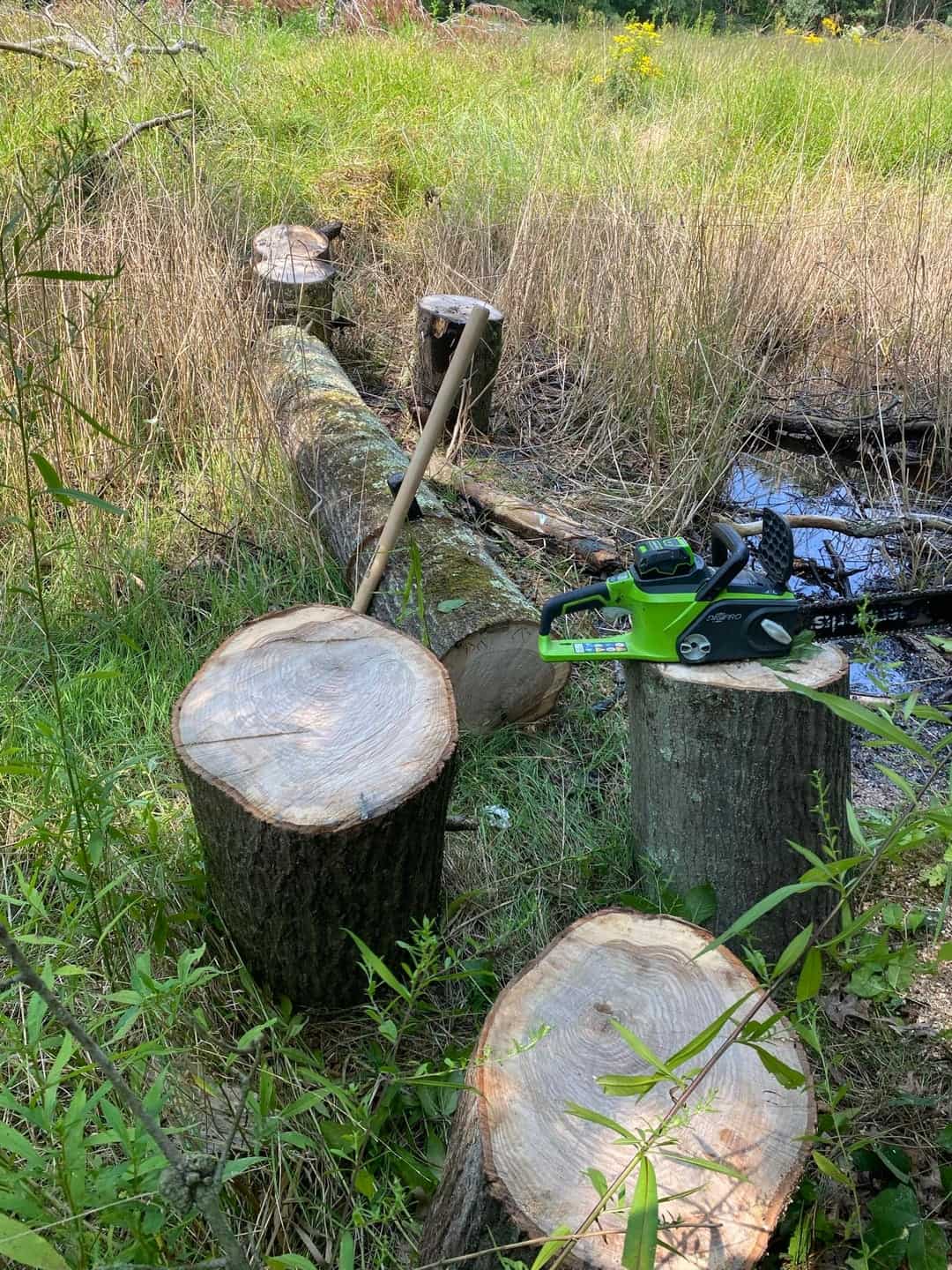
Not long after we moved onto our property, I found myself dealing with a very large fallen white pine. I would eventually find myself dealing with an oak tree, too.
My chainsaw?
Still the little Greenworks 40V with its 16-inch bar.
Looking back, I can safely say that I underestimated the work involved and overestimated what I should reasonably expect from a relatively small battery-powered chainsaw.
I wouldn't personally choose this particular chainsaw for those jobs today. I own larger gasoline chainsaws now, and there are situations where I would seek professional assistance rather than tackle a tree myself.
But at the time, the Greenworks was what I had.
And much to my surprise, it managed to get through both jobs.
Fortunately, I documented quite a bit of that work through photographs and videos over the years.
After a major spring storm brought down a large white pine, I put the Greenworks to work.
This was considerably more demanding than cutting a few branches or smaller pitch pines.
I found myself going through batteries, attending to the chain and repeatedly cleaning the chainsaw throughout the job.
It certainly wasn't a quick or particularly convenient process, but the chainsaw kept working.
I was surprised by what this relatively small machine was capable of accomplishing.
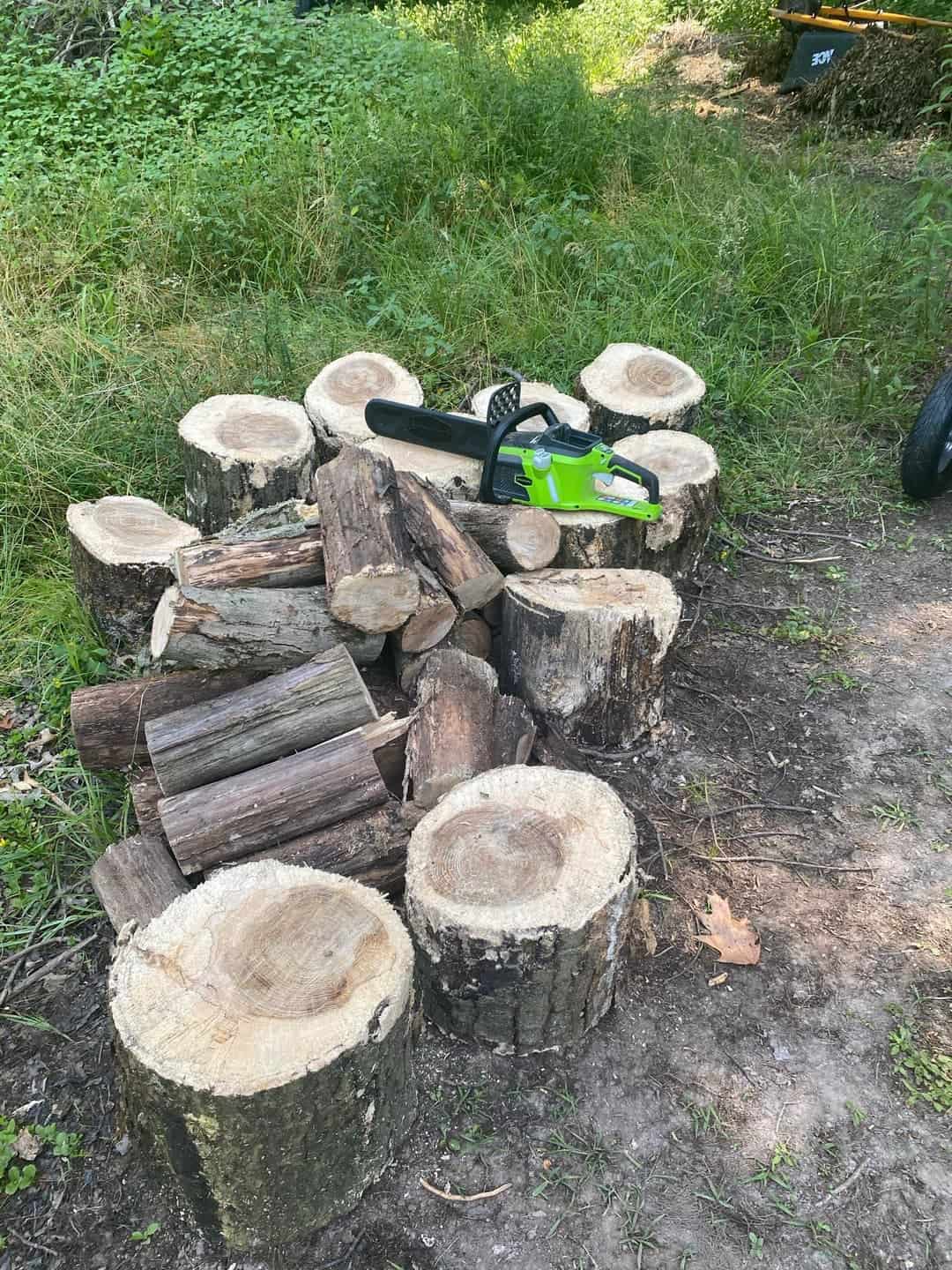
The oak tree was another experience entirely.
Working through larger pieces of hardwood was where I became particularly aware of the limitations of my Greenworks chainsaw.
With a 16-inch bar and a 4.0Ah battery, I was asking quite a lot of it.
The batteries didn't last particularly long during demanding cuts, and the chain required frequent attention. I sharpened it so many times throughout my larger cleanup projects that I've long since lost count.
Yet the chainsaw managed to get through the work.
Was it the most efficient piece of equipment for the job? I certainly don't think so.
Did it accomplish what I needed at the time?
Surprisingly, yes.
These experiences aren't a recommendation to use a small cordless chainsaw on large trees. They're simply an honest account of what happened when I was inexperienced, under-equipped and trying to maintain our property.
What five years of replacement batteries cost me
If there is one subject that deserves particular attention in this chainsaw review, it's the batteries.
For smaller jobs around our property, I found the Greenworks 40V 4.0Ah battery quite convenient.
Once I started dealing with larger trees, my experience changed considerably.
I quickly realized that relying on a single battery was not going to work for the amount of wood I was dealing with.
I eventually made a habit of keeping two to three charged batteries available for larger jobs. Having a charger readily available became part of my routine.
That worked reasonably well for me, but there was another problem I hadn't anticipated when I originally purchased the chainsaw.
The batteries themselves wouldn't last forever.
And I don't just mean running out of charge in the middle of a job.
Over the past five years, I've had at least three original Greenworks 40V 4Ah batteries fail entirely.
They simply stopped accepting a charge.
I particularly noticed battery problems during the period when I was putting the chainsaw through demanding hardwood cutting jobs.
I suspect that the amount of work I was asking of the equipment may have contributed to those failures, but I'm not a battery technician. I don't know precisely what happened inside those batteries or what caused them to stop working.
Each time, I purchased replacements.
I haven't kept an exact record of every battery purchase, but if I had to estimate, I've probably spent somewhere around $400 on replacement batteries over the years.
That's quite a bit of money.
When I originally chose a cordless chainsaw, part of its appeal was that I wouldn't constantly have to purchase gasoline.
What I didn't fully appreciate at the time was the potential long-term expense of replacing batteries.
That's not to say that a gasoline chainsaw doesn't have its own recurring expenses. It certainly does.
But the cost of replacement batteries is something I can't honestly leave out when discussing my experience with Greenworks.
What's particularly interesting to me is that several batteries have died over the years, yet the chainsaw itself is still running.
Wet wood, sawdust and chain maintenance
We live in a rather swampy area.
Much of the storm damage I deal with involves fallen wood that has been sitting on wet ground, surrounded by mud, leaves and other debris.
One thing I repeatedly encountered with my Greenworks chainsaw was the accumulation of damp sawdust and debris underneath the plastic cover around the chain tensioning mechanism.
During particularly dirty jobs, this would interfere with the smooth operation of the chain.
I found myself having to stop work and clean the area regularly.
Fortunately, I didn't find cleaning the chainsaw particularly difficult.
Over the years, this little machine has encountered plenty of dirt, mud, wet timber and less-than-ideal working conditions.
I am genuinely surprised by how well the chainsaw itself has held up.
That doesn't mean I consider it waterproof, nor would I recommend exposing electrical equipment to water. Its survival doesn't establish that those conditions were safe or within the manufacturer's operating limits.
It simply gives you an idea of the conditions it has encountered on our property.
The chain itself has certainly taken a beating over the years.
During the larger white pine and oak projects, sharpening the chain became a frequent part of my routine.
Greenworks lists a 5/32-inch (4 mm) round file for sharpening the chain supplied with this model. Replacement chains may have different requirements, so the specifications of the actual chain fitted to the saw matter.
I have found replacing the bar and chain, adjusting tension and maintaining the oil level to be fairly straightforward.
The automatic oiler is another feature I appreciate.
Of course, cordless doesn't mean maintenance-free. The bar and chain still require attention, regardless of whether the chainsaw runs on gasoline or a battery.
For maintenance procedures, I would refer readers to the official Greenworks product support and owner's manual. The battery must be removed before carrying out maintenance.
I'm sharing my ownership experience here, not writing a professional chainsaw maintenance guide.
When I reach for my gas saw instead
My garage looks quite different today than it did when we first moved onto our property.
I now own a Husqvarna 440 and a Black Max 20-inch 50cc gasoline chainsaw, in addition to my Greenworks equipment.
Earlier this year, I used my Husqvarna 440 to process a gigantic green ash that had fallen across our driveway and struck part of our house during a severe storm.
That job gave me another opportunity to appreciate the differences between the chainsaws I own.
I can spend several hours working with my gasoline chainsaw, refuel it and get back to work without waiting for a battery to charge.
But there are plenty of smaller jobs where I still appreciate the convenience of my Greenworks.
I don't necessarily see one type of chainsaw as a replacement for the other anymore.
I've simply developed a better understanding of which chainsaw I personally prefer for different jobs around our property.
Read about my biggest property job of 2026 with the Husqvarna 440.
Does my Greenworks 40V chainsaw still run?
Yes.
In fact, I took it out and tested it again just two weeks ago, and it still runs smoothly.
After all the white pine, oak, storm damage, dirt, mud, dead batteries and countless sharpening sessions, the chainsaw itself is still sitting in my garage, ready for another job.
These days, I tend to use it for the smaller tasks I feel it is better suited to.
I have other chainsaws available now, and I no longer feel the need to put the Greenworks through every large cleanup project that comes my way.
Perhaps I've learned a thing or two after all.
What held up and where I hit its limits
This isn't a laboratory test, nor have I compared every cordless chainsaw currently available on the market.
These are simply the things that have stood out to me over several years of ownership.
What I like
- Its relatively light, compact construction.
- How easy I find it to start.
- Straightforward routine maintenance.
- Tool-free chain tensioning.
- The convenience of cordless operation for smaller jobs.
- Its surprising durability over five years of demanding use.
- Its ability to share compatible batteries with other Greenworks 40V equipment.
The drawbacks
- Limited battery runtime during demanding hardwood cutting.
- The need to keep several batteries available during larger projects.
- At least three batteries permanently failing.
- The accumulated cost of replacement batteries.
- Debris collecting around the chain tensioning mechanism during dirty jobs.
- The limitations I encountered when working with larger trees.
Would I buy it again?
My overall experience with this chainsaw has been a pleasant one.
I particularly appreciate how user-friendly it has been for someone who began maintaining ten acres with very little experience and practically no outdoor equipment.
It introduced me to chainsaw work without some of the complications I associated with gasoline-powered equipment at the time.
Would I use it today for the same enormous jobs I attempted during our first years here?
Probably not.
But I don't think that takes away from what this particular chainsaw has accomplished.
Am I disappointed that several of my Greenworks batteries failed? Absolutely. Spending roughly $400 on replacements wasn't something I had anticipated when I purchased the chainsaw.
Yet I would find it equally difficult to ignore the fact that the chainsaw itself continues to operate smoothly after more than five years.
Both experiences belong in an honest account of my ownership.
I own several other Greenworks tools, including a mower and trimmers. Not all of them have given me the same experience as this chainsaw.
In fact, one of my Greenworks weed whackers eventually went up in smoke.
Quite literally.
But that's a story for another article.
For now, my little Greenworks chainsaw has earned its place in my garage.
Five years later, I'm still using it.
Sometimes I win. Sometimes the yard does.